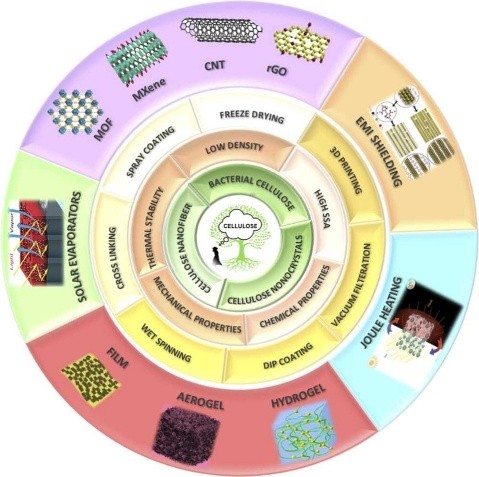

 As modern electronics become smaller and more powerful, they trap significant amounts of heat and are highly prone to electronic interference, such as static or dropped signals. Traditional metal parts are too heavy and rigid to solve these issues. To tackle this problem, scientists are turning to nanocellulose, a sustainable and flexible material derived from plant matter. By blending nanocellulose with advanced microscopic components—including metallic MXenes, conductive carbon nanotubes, and sponge-like metal-organic frameworks (MOFs)—researchers have successfully created smart, ultra-lightweight hybrid materials. Rather than acting as a simple glue, the nanocellulose perfectly organizes these advanced ingredients into intricate, tiny patterns. Dr Suraj Kumar Bhagat from the Department of Centre for Inter Disciplinary Research delves deep into these structures in his paper “Beyond Structural Support: Synergizing Nanocellulose with MXene, Carbon, and MOFs for Integrated EMI Shielding, Thermal Management, and Solar Evaporation”, published in the Q1 journal of ‘Materials Science and Engineering: R: Reports’, having an impact factor of 26.8.
These newly engineered hybrid structures are highly multifunctional, capable of blocking harmful electronic interference and quickly generating and managing heat. Beyond electronic applications, these innovative materials can even harness sunlight to evaporate water, making them useful for environmental cleanup efforts. While these eco-friendly composites work beautifully in laboratory settings, the critical next step is finding viable methods to mass-produce them safely, cheaply, and without using toxic chemicals. Incorporating artificial intelligence to design these materials will be key to overcoming production hurdles and transforming them into the foundational backbone of next-generation gadgets.
A brief abstract of the research
Recent advancements in nanocellulose (NC)-based nanocomposites have driven a paradigm shift from traditional, single-function materials toward sustainable, high-performance multifunctional architectures. By synergizing the amphiphilic nature and structural resilience of NC with highly conductive or porous building blocks—such as MXenes, carbon nanotubes (CNTs), reduced graphene oxide (rGO), and metal-organic frameworks (MOFs)—researchers have engineered hierarchical 1D, 2D, and 3D composites. These hybrid systems transcend passive structural roles, delivering exceptional electromagnetic interference (EMI) shielding, precise Joule heating, and efficient solar-driven evaporation through multiscale transport control and optimized interfacial polarization. Despite outstanding laboratory successes, wide-scale industrial deployment is currently bottlenecked by performance-process trade-offs, scalability challenges, and a lack of rigorous toxicological data. Future commercial translation depends on integrating data-driven design tools, adopting continuous manufacturing methods, and implementing life-cycle assessments (LCA) to align these advanced material platforms with circular economy principles and Net-Zero objectives.
Practical Implementation and Social Implications
This research directly accelerates the development of next-generation green electronics and decentralized clean water systems. By replacing heavy, rigid, and resource-intensive metals with lightweight, plant-based nanocellulose hybrids, manufacturers can create highly flexible, wearable devices and smarter smartphones that do not overheat or suffer from signal interference. Socially, this material shift supports global Net-Zero objectives. Transitioning away from carbon-heavy metal processing toward renewable plant matter significantly lowers the electronics industry’s carbon footprint. Furthermore, the material’s ability to drive highly efficient solar evaporation offers a low-cost, decentralized solution for water purification and desalination in remote or disaster-stricken communities. By leveraging artificial intelligence to safely scale up production, this research bridges the gap between high-tech performance and environmental justice, turning industrial waste and plant fibers into critical tools for human health and technological equity.
Future research plans.
To transition these nanocellulose (NC) hybrids from laboratory successes to commercial realities, future research will focus on three critical pillars: Prioritizing the replacement of toxic, fluoride-based etching in MXene production with eco-friendly alternatives like Lewis acid pathways. Research will also pivot from batch processing to continuous assembly methods, such as roll-to-roll (R2R) vacuum filtration and automated spray coating, to ensure industrial scalability (Green, Scalable Manufacturing). Integrating Artificial Intelligence (AI) and Machine Learning (ML) with molecular dynamics simulations to predict composite performance. This will eliminate traditional trial-and-error synthesis, optimizing interfacial bonding before physical fabrication (Data-Driven Design). Conducting rigorous, long-term in vitro and in vivo toxicological assessments to ensure safety against nanofiller leaching. Research will establish closed-loop recycling strategies for valuable transition metals, ensuring these multifunctional materials align perfectly with global Net-Zero and circular economy goals (Safety and Circularity).
Link to the article
https://www.sciencedirect.com/science/article/pii/S0927796X26000628#sec0130