 Rajiv Senapati, Assistant Professor, Department of Computer Science and Engineering and Ms Stutee Mohanty, PhD Scholar has filed and published a patent titled “System and Method for Real-Time Digital Image Shadow Removal.”
Research focuses on automatically removing unwanted shadows from digital images in real time, making images clearer, more accurate, and more useful for both humans and computer systems. Shadows often hide important details, reduce image quality, and create problems in applications such as surveillance, medical imaging, autonomous vehicles, remote sensing, and defence systems.
The proposed system uses advanced image processing and intelligent learning techniques to detect shadow regions and separate them from the actual objects in the image. Instead of simply brightening dark areas, the method carefully analyses texture, color, and illumination patterns so that the original appearance of the object is preserved while the shadow is removed naturally. In simple terms, imagine taking a photograph where a person or object is partially covered by a strong shadow. Our system works like a smart “digital cleaner” that identifies which dark regions are true shadows and which are actual object features, then removes only the shadow without damaging the real content. The novelty of this work lies in performing this process in real time, meaning the system can work quickly enough for live applications such as CCTV monitoring, military reconnaissance, smart traffic systems, and robotic vision. This improves decision-making by providing clearer visual information instantly.
Abstract
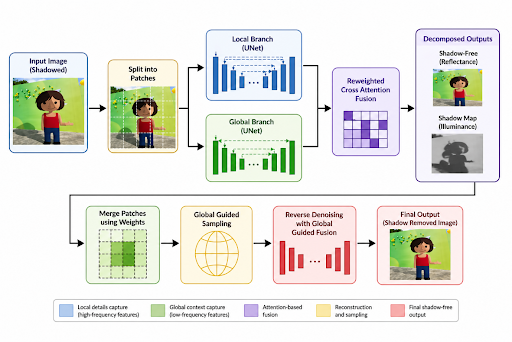
The patent titled “System and Method for Real-Time Digital Image Shadow Removal” has been successfully filed and published. This invention presents an intelligent framework for removing unwanted shadows from digital images in real time using a lightweight dual-branch diffusion architecture. The system combines local and global processing branches to restore fine image details while maintaining overall illumination consistency. A Reweighted Cross Attention mechanism and Global Guided Sampling module improve image quality by reducing shadow effects, preserving textures, and eliminating patch boundary artifacts. The framework is designed for resource-constrained devices such as mobile phones, surveillance systems, drones, and autonomous vehicles. This research has significant applications in defence, smart surveillance, medical imaging, remote sensing, and autonomous systems where clear and accurate images are essential for reliable decision-making.
Practical implementation of our research
This research improves real-time image clarity by automatically removing shadows without affecting important object details. It can be used in surveillance, autonomous vehicles, medical imaging, smart traffic systems, remote sensing, and defence monitoring. In defence, it supports better target detection and border surveillance. Socially, it improves public safety, reduces decision-making errors, and helps AI systems make more accurate and reliable predictions in critical real-world applications.
Future research plans
Future research plans focus on developing more robust and intelligent image security and enhancement frameworks for real-world applications. I aim to extend this work by integrating deep learning, federated learning, and zero-watermarking techniques for secure image transmission and copyright protection. I also plan to explore hyperspectral and thermal image watermarking for defence and remote sensing applications, with emphasis on robustness against AI-based attacks, privacy preservation, and real-time implementation in large-scale practical systems.