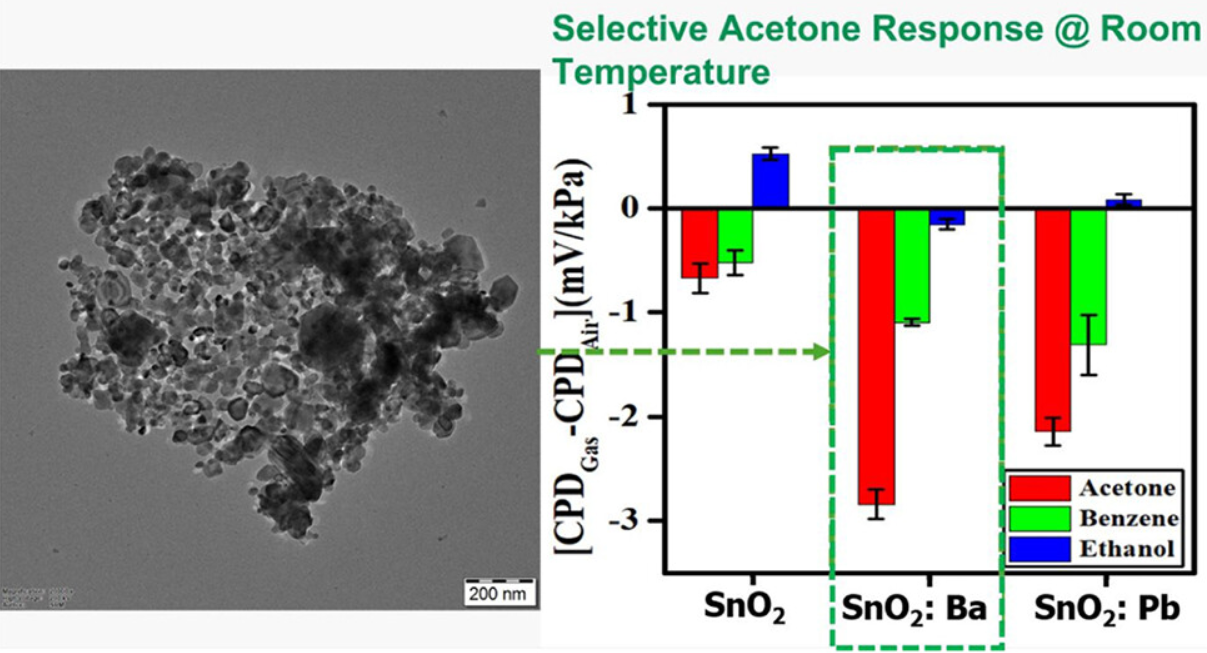

 Dr Rahul Suresh Ghuge, Post-Doctoral Researcher in the Centre for Interdisciplinary Research, SRM AP has published a research paper in Q1 journal ACS Applied Nano Materials, having an impact factor of 5.5 , on the topic of “Enhanced Room-Temperature Acetone Detection Enabled by Ba and Pb-Doped SnO2: A Scanning Kelvin Probe Study”.
In this study, researchers developed a smart material that can detect harmful gases like acetone at room temperature without needing heat or high power. This makes the sensor more energy-efficient and suitable for portable devices. By modifying the material with specific elements, we improved its ability to sense gases quickly and accurately, which can help in health monitoring and industrial safety.
Researchers have developed an advanced smart material capable of detecting harmful gases such as acetone at room temperature, eliminating the need for heat or high power consumption. This breakthrough makes the sensor highly energy-efficient and ideal for portable and wearable devices. By carefully modifying the material with selected elements, the team significantly enhanced its sensitivity, speed, and accuracy in gas detection. The innovation holds strong potential for applications in health monitoring, environmental sensing, and industrial safety systems. His contributions encompassed scanning Kelvin probe (SKP) measurements, comprehensive data analysis and interpretation of surface charge dynamics. Additionally, he played a significant role in manuscript preparation, writing, and editing.
Brief Abstract
The study reports the synthesis and investigation of Ba- and Pb-doped SnO₂ thin films for room-temperature acetone detection using the scanning Kelvin probe (SKP) technique. The doped materials exhibit enhanced surface charge transfer and adsorption behavior, resulting in significant contact potential difference (CPD) responses compared to pristine SnO₂. The improved sensing performance is attributed to dopant-induced surface defects and increased active sites. This work demonstrates an energy-efficient strategy for VOC detection without external heating, offering a promising approach for low-power gas sensing applications.
Practical Implementation / Social Implications
The developed sensing platform offers significant potential for real-time monitoring of volatile organic compounds in industrial environments, reducing health risks associated with toxic gas exposure. Additionally, its low-power operation and room-temperature functionality make it suitable for wearable and portable devices, including breath analyzers for noninvasive medical diagnostics.
Future Research Plans
Future work will focus on extending this approach to other VOC biomarkers, integrating the sensing platform with IoT-enabled systems for real-time monitoring, and exploring advanced nanostructures and hybrid materials to further enhance sensitivity and selectivity