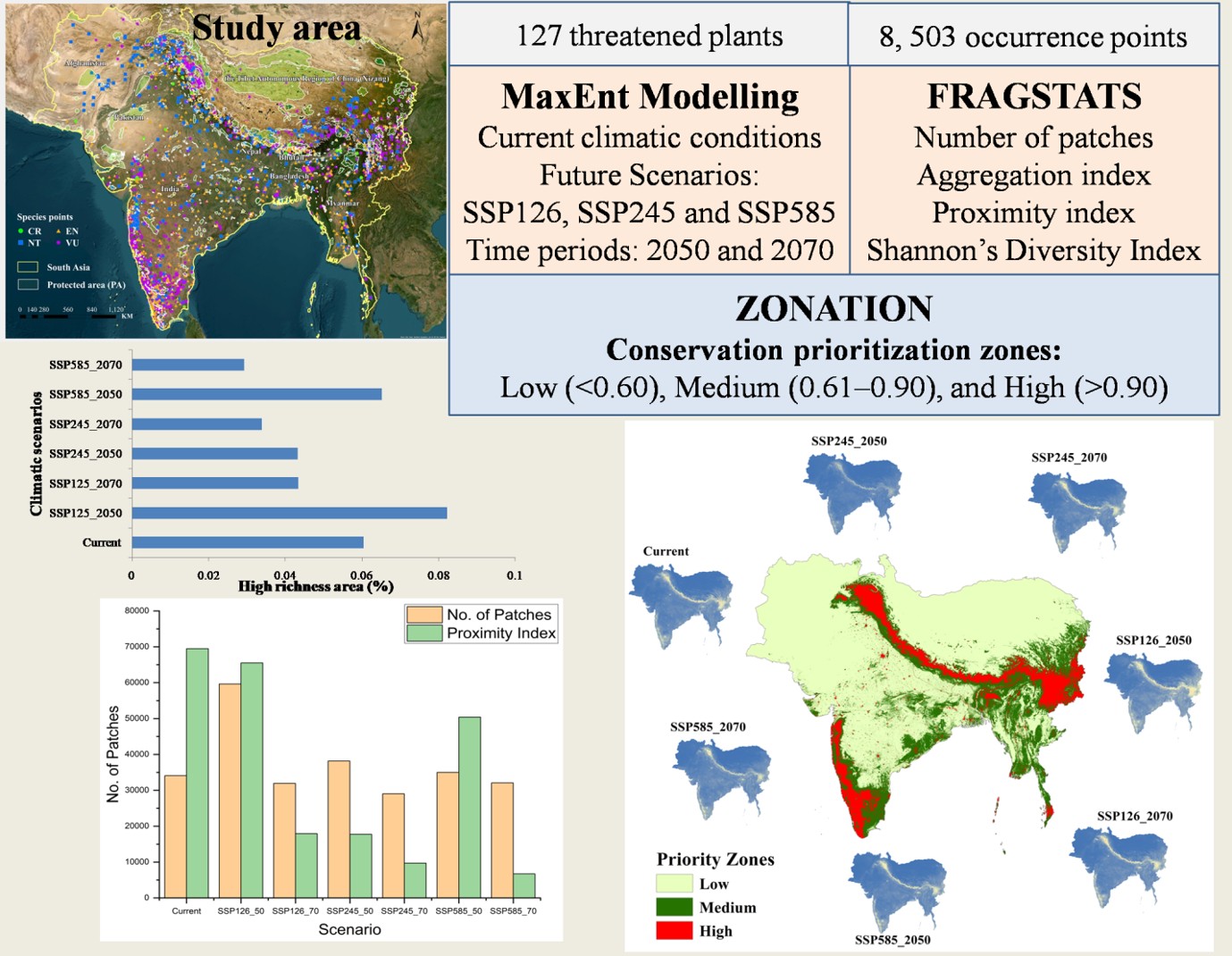

 Dr Zishan Ahmad Wani, Post-Doctoral Fellow from the Department of Environmental Science and Engineering, SRM AP has published a research paper titled “Conservation Deficits and Climate-Driven Habitat Shifts of Threatened Plants in South Asia” on the Q1 journal of Geography and Sustainability (Elsevier), with an impact score of 8.0. In this paper, the researcher highlights that climate change drives distributional shifts and the loss of suitable habitats for threatened plants in South Asia. So, there is an urgent need for integrated policy frameworks to address climate-driven range shifts, habitat fragmentation, and conservation shortfalls, thereby strengthening biodiversity resilience across South Asia.
Abstract
The study integrated MaxEnt-based species distribution modelling, habitat fragmentation analysis, and spatial conservation prioritization to assess current and future conservation priorities for 127 threatened plant species across South Asia. MaxEnt modelling revealed that under current climatic scenarios, only 6.05 % of the total area was predicted to be highly suitable for these species. Future climate projections indicate increased fragmentation and declining connectivity across all scenarios. Spatial prioritization identified 912,037 km2 as high-priority zone; 85.01 % of which lies outside the existing protected area networks.
Practical Implications
The results revealed that the existing protected area networks insufficiently represent climate niches of threatened plants in South Asia. Thus, there is a need to expand and connect protected areas and implement adaptive, climate-informed conservation strategies to safeguard South Asia’s threatened flora under rapid environmental change. The research provide foundational knowledge to refine conservation approaches aligned with climate forecasts, enhancing proactive and efficient strategies to mitigate species and ecosystem threats posed by climate extremities
Collaborations
The research was carried out in collaboration with the authors from i) Xishuangbanna Tropical Botanical Garden, Chinese Academy of Sciences; ii) Institute of Botany, Ilia State University, Tbilisi, Georgia; and iii) Centre for Rainforest Studies, School for Field Studies, Yungaburra Qld, Australia.
Future Research Plans
Effectiveness of protected area networks in conserving biodiversity will be evaluated.
A database of biodiversity within protected areas of India will be created.