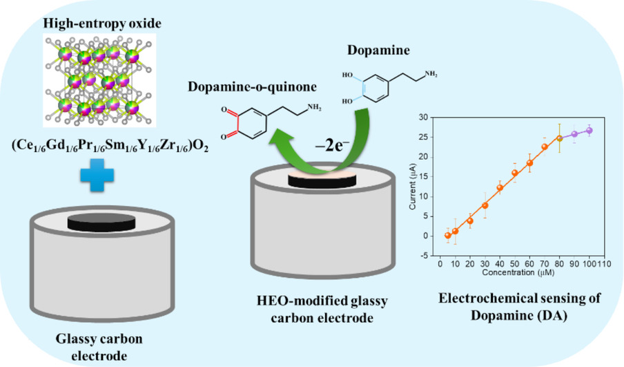

 Dopamine is a crucial brain chemical that helps control mood, movement, and thinking. Irregular levels of dopamine are often linked to major neurological conditions, making accurate detection vital for medical testing and disease research.
To address this need, Dr Venkata Ramesh Naganaboina, Assistant Professor from the Department of Electronics and Communication Engineering in SRM AP successfully developed a new sensor to measure dopamine levels accurately and affordably. This study was published under the title “Non-enzymatic dopamine sensing using high-entropy oxide-modified carbon paste electrodes” in the Q1 journal of Inorganic Chemistry Communications, having an impact factor of 5.4. They made the sensor by coating a carbon paste electrode with nanoparticles made from a special mixed (high-entropy) metal oxide.
This advanced coating significantly improved the sensor’s ability to catch dopamine and turn it into a measurable signal. The newly developed device works exceptionally well even at low dopamine levels. It provides highly consistent results and is not easily confused by other substances in the testing environment.
Abstract:
Dopamine (DA) is an essential catecholamine neurotransmitter in the human body responsible for cognitive function. Its irregularities are linked to several neurological illnesses, including Alzheimer’s disease and depression. Therefore, accurate detection of DA is a topic of considerable interest. In the present work, a non-enzymatic electrochemical sensor was fabricated by modifying a carbon paste electrode (CPE) with solution combustion-synthesized high-entropy (Ce1/6Gd1/6Pr1/6Sm1/6Y1/6Zr1/6)O2 oxide nanoparticles. The prepared nanoparticles exhibit a single-phase cubic fluorite structure (Fm-3m) with spongy nanostructures along with a uniform distribution of all principal elements. The prepared high-entropy (Ce1/6Gd1/6Pr1/6Sm1/6Y1/6Zr1/6)O2 oxide nanoparticle-modified CPE electrode material was utilized in the electrochemical detection of DA. The results show that high-entropy oxide nanoparticles improve the electrochemical properties of the modified electrode. The fabricated sensor shows good electrochemical sensing activity with a limit of detection (LOD) of 3.83 μM. The oxygen vacancies played a significant role in improving the DA sensing while enhancing the reproducibility, repeatability, and interference ability.
Practical Implementation
The practical use of this research is a low-cost sensor that could help measure dopamine in biological samples more quickly and simply than many lab-based methods. In real settings, that could support early screening, medical monitoring, and research on disorders linked to dopamine imbalance, such as Parkinson’s disease and depression.
Social Implications
Its social impact is mainly in healthcare access: simpler sensors can make testing cheaper, faster, and more portable, which matters in clinics with limited equipment. It could also help researchers study brain chemistry more precisely, improving understanding of neurological and psychiatric conditions. A broader implication is that better neurotransmitter sensing may lead to more personalized treatment decisions, but it also raises questions about data privacy, medical over-testing, and unequal access if the technology is not widely deployed.
Collaborations
- South Ural State University, Chelyabinsk 454080, Russian Federation
- Department of Electrical Engineering, Indian Institute of Technology Hyderabad, Kandi 502284, Telangana, India
- Department of Chemistry, Saveetha Engineering College, Chennai 602105, Tamil Nadu, India
Future research plans
Subsequent steps stemming from this work may include device packaging and long-term stability testing; integration with low-power readout electronics and wireless modules for IoT deployment; scaling up manufacturing to reduce costs; and testing under various real-world indoor and outdoor conditions to validate performance.
Link to the article