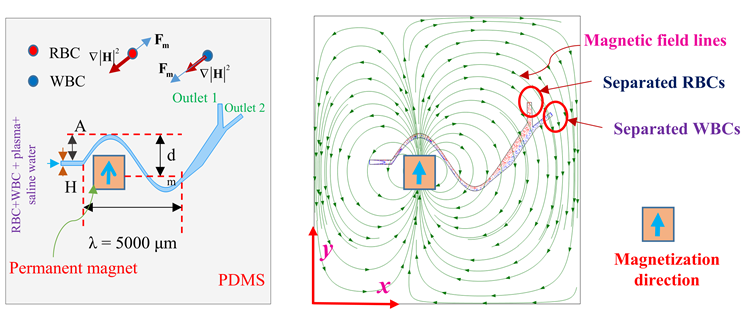

 In the current medical testing field, the urgent need to diagnose diseases quickly, reduce healthcare costs, and transition toward accessible testing has intensified interest in micro-channels as a clean and efficient separation technology. However, the large-scale deployment of these tools is constrained by the difficulty of sorting tiny cells accurately. In this context, the research by Dr Sumit Kumar Mehta, Assistant Professor, Department of Energy Engineering from SRM AP addresses these critical challenges through the development of advanced computer simulations that show how channel shapes and magnetic placements guide red and white blood cells to different locations. His research is published in the IEEE Transactions on Magnetics having an impact factor of 2.1, titled Computational Investigation of Magnetophoretic Separation of Blood-Cell-Inspired Particles in Serpentine Microchannels.
Abstract
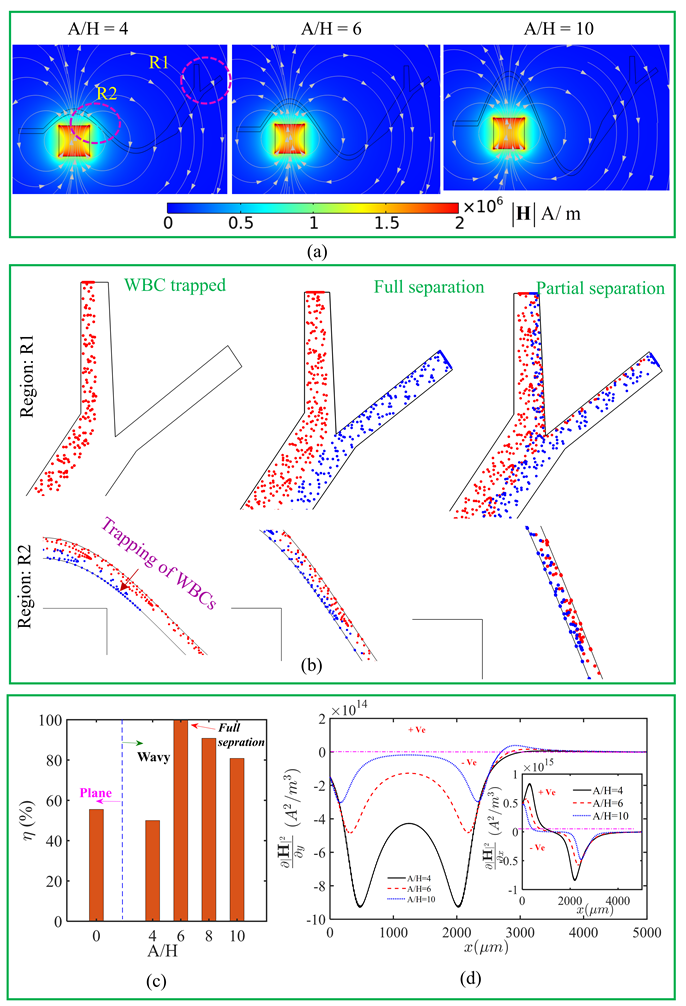
This study numerically investigates the magnetophoretic separation of blood-cell-inspired particles in serpentine microchannels under saline-water-diluted conditions. The effects of channel geometry, magnetic configuration, and flow conditions on particle trajectories and separation performance are analysed. Results show that serpentine channels, particularly with square-shaped magnets, generate stronger magnetic field gradients and achieve improved separation efficiency. The findings provide computational design guidelines for optimising magnetophoretic microfluidic separators for lab-on-chip biomedical applications.
Practical Implementation and social implications
The findings of this research can support the development of compact and low-cost lab-on-a-chip devices for rapid blood analysis and medical diagnostics. Such systems could enable faster disease detection, reduce testing costs, and improve access to healthcare, particularly in resource-limited and remote areas.
Collaborations
This research was conducted through national and international collaboration involving, Prof. Pranab Kumar Mondal from the Department of Mechanical Engineering, Indian Institute of Technology Guwahati (IIT Guwahati), India, and Prof. Somchai Wongwises from the Department of Mechanical Engineering, Faculty of Engineering, King Mongkut’s University of Technology Thonburi (KMUTT), Thailand.
Future Research Plans
The future research will focus on microfluidics, electrokinetics, and thermal-fluid sciences, with emphasis on developing intelligent lab-on-chip systems, advanced thermal management technologies, and energy-efficient microdevices through a combination of computational modeling, experiments, and AI-driven design