
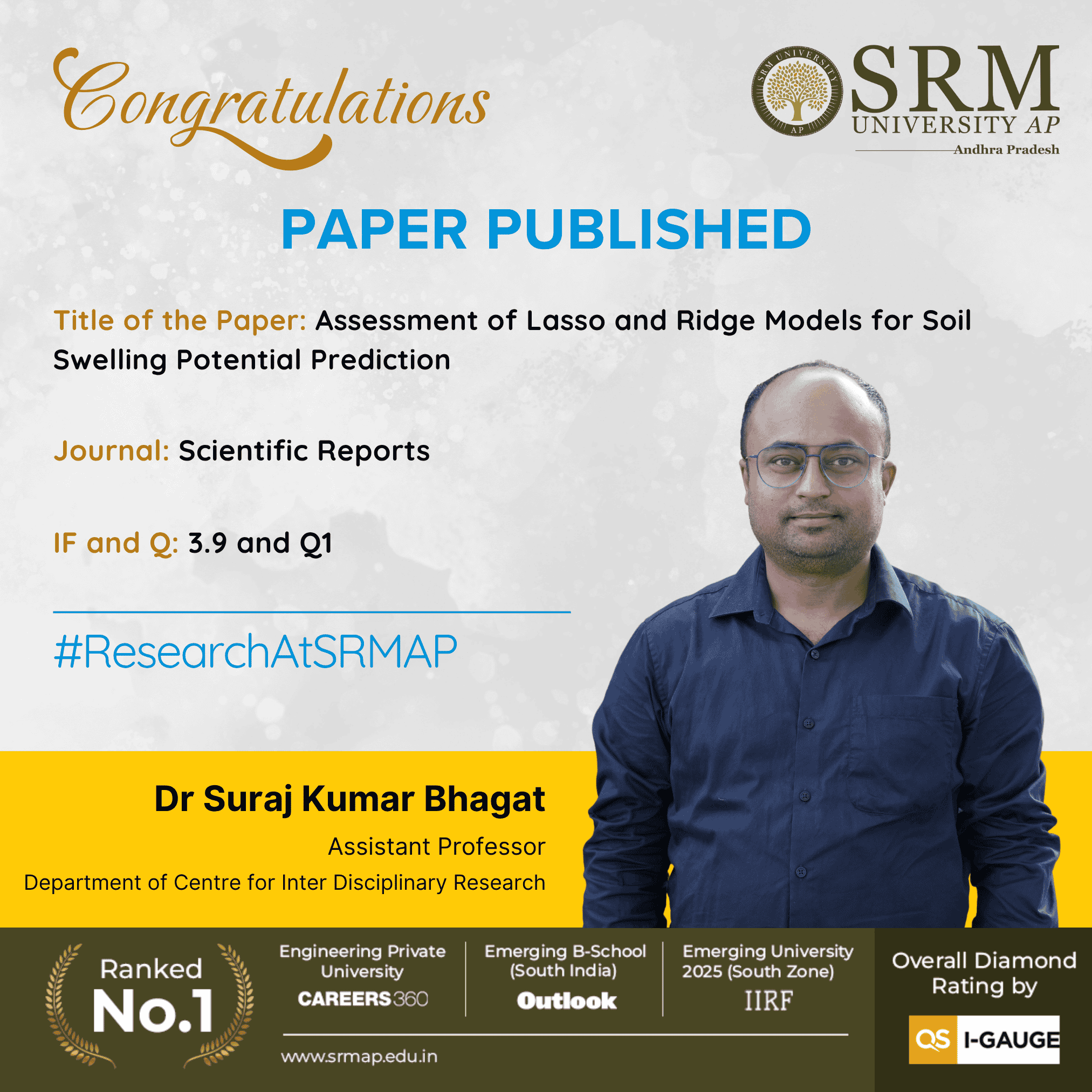
 Dr Suraj Kumar Bhagat, Assistant Professor, Centre for Interdisciplinary Research, has published a research paper titled “Assessment of Lasso and Ridge Models for Soil Swelling Potential Prediction” in the prestigious Q1-ranked journal Scientific Reports with an Impact Factor of 3.9.
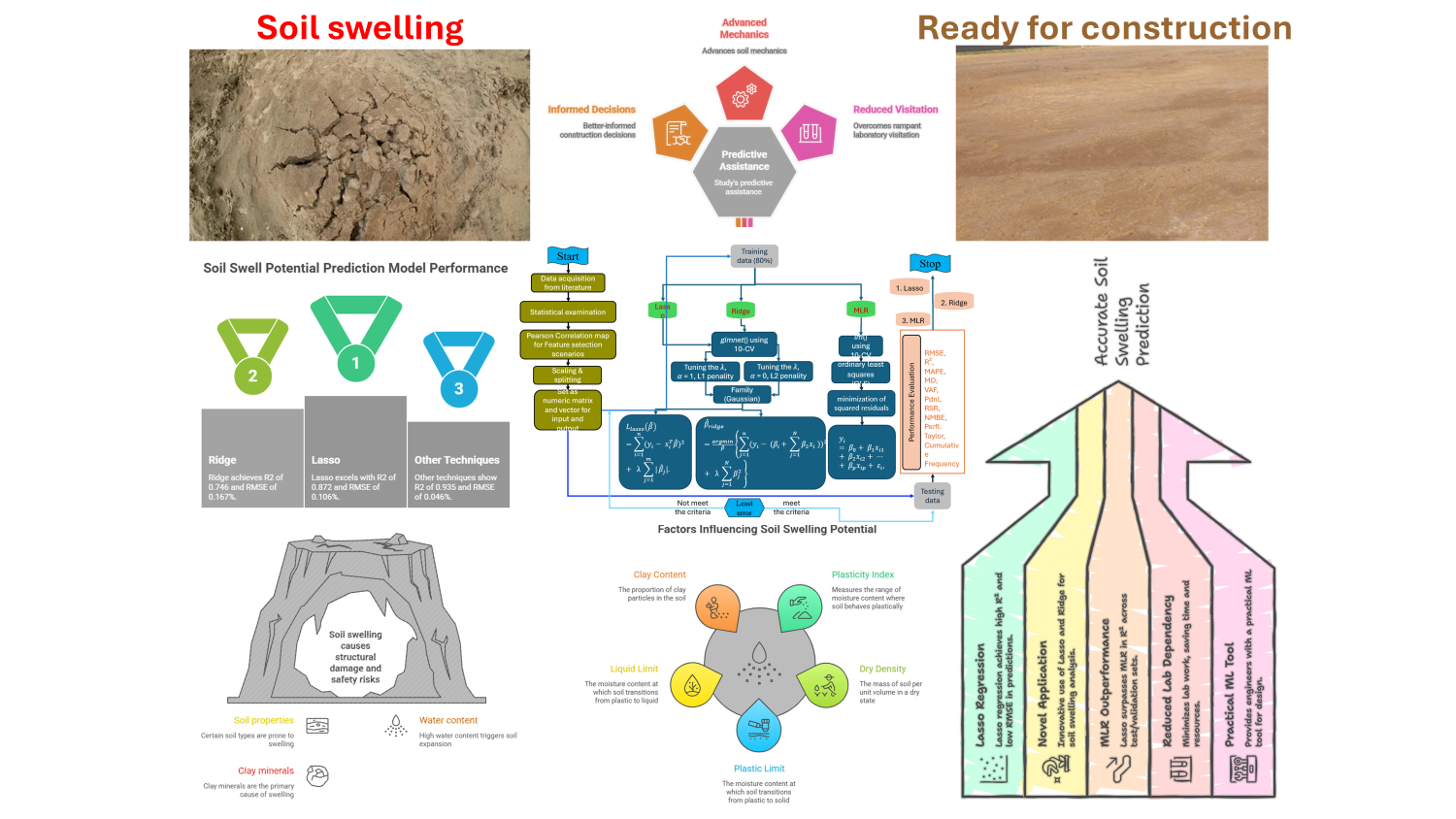
The research addresses one of the persistent challenges in geotechnical and civil engineering predicting the swelling behaviour of expansive soils. These soils undergo significant expansion when exposed to moisture and contract upon drying, creating instability that can lead to structural damage in buildings, roads, and other critical infrastructure. Accurate prediction of soil swelling potential is therefore essential for ensuring safe and sustainable construction practices.
To overcome the limitations of conventional laboratory-based testing methods, which are often time intensive and resource demanding, the study explores the use of advanced machine learning approaches to predict soil behaviour. Using historical soil characteristics, including clay content and moisture-related properties, the research evaluated three predictive models: Multiple Linear Regression (MLR), Ridge Regression, and Least Absolute Shrinkage and Selection Operator (LASSO).
Among the approaches tested, the LASSO model demonstrated superior performance by efficiently identifying the most influential soil parameters while minimising the effect of less relevant variables. This selective learning capability enabled more accurate prediction of soil swelling potential compared to traditional methods.
The findings highlight the growing role of data-driven intelligence in engineering applications and demonstrate how machine learning can support faster, more reliable, and cost-effective decision-making in infrastructure planning and construction.
Brief abstract
Soil swelling poses a major threat to structural stability, making accurate prediction crucial for geotechnical engineering. This study evaluates the application of two regularised machine learning techniques—Least Absolute Shrinkage and Selection Operator (LASSO) and Ridge regression—alongside traditional Multiple Linear Regression (MLR) to predict the one-dimensional swelling potential of expansive soils. Utilising an extensive database of key geotechnical properties, including plasticity index, dry density, and liquid limit, the models were evaluated using R2, RMSE, MAPE, and MD metrics. The results demonstrate that LASSO outperformed both Ridge and MLR, achieving a peak R2 of 0.935 due to its superior feature selection capability. While MLR proved unreliable for complex soil behavior, the regularised models effectively mitigated multicollinearity. These findings highlight the potential of machine learning to reduce costly laboratory testing, aiding engineers in making informed, sustainable construction and foundation design decisions.
Practical implementations:
This research offers vital practical and social benefits by transforming how infrastructure is built in regions with unstable ground. By implementing the LASSO machine learning model, civil engineers can instantly predict soil swelling risks using existing data, bypassing weeks of costly, repetitive laboratory testing.
Practically, this accelerates the design and construction phases of critical projects like highways, residential foundations, and earthworks. Socially, the research directly enhances community resilience and public safety. Expansive soils cause billions of dollars in structural damage globally; by providing a highly accurate, accessible tool for risk assessment, this model helps prevent cracked foundations, road failures, and structural collapses.
Ultimately, integrating these data-driven workflows into geotechnical engineering fosters sustainable, cost-effective urban development, ensuring safer housing and more reliable public infrastructure in vulnerable expansive soil zones worldwide.
Collaborations
Marwadi University, India
Future Plans:
To build upon these findings, future research will focus on expanding the model’s datasets to incorporate a wider variety of global soil types, ensuring greater geographical generalizability. Additionally, the current static models will be upgraded by integrating real-time environmental data, such as shifting climate patterns, seasonal groundwater fluctuations, and long-term wetting-drying cycles, to better simulate real-world conditions.
Another critical avenue of study involves improving the transparency and interpretability of these AI frameworks. While LASSO offers excellent feature selection, incorporating “Explainable AI” (XAI) techniques will help engineers clearly visualise how the algorithms weigh specific soil parameters.
Finally, researchers plan to develop a user-friendly, open-access digital tool or mobile application, allowing field engineers to input basic geotechnical properties and instantly receive accurate swell potential predictions, effectively bridging the gap between advanced machine learning theory and practical, on-site civil engineering application.