

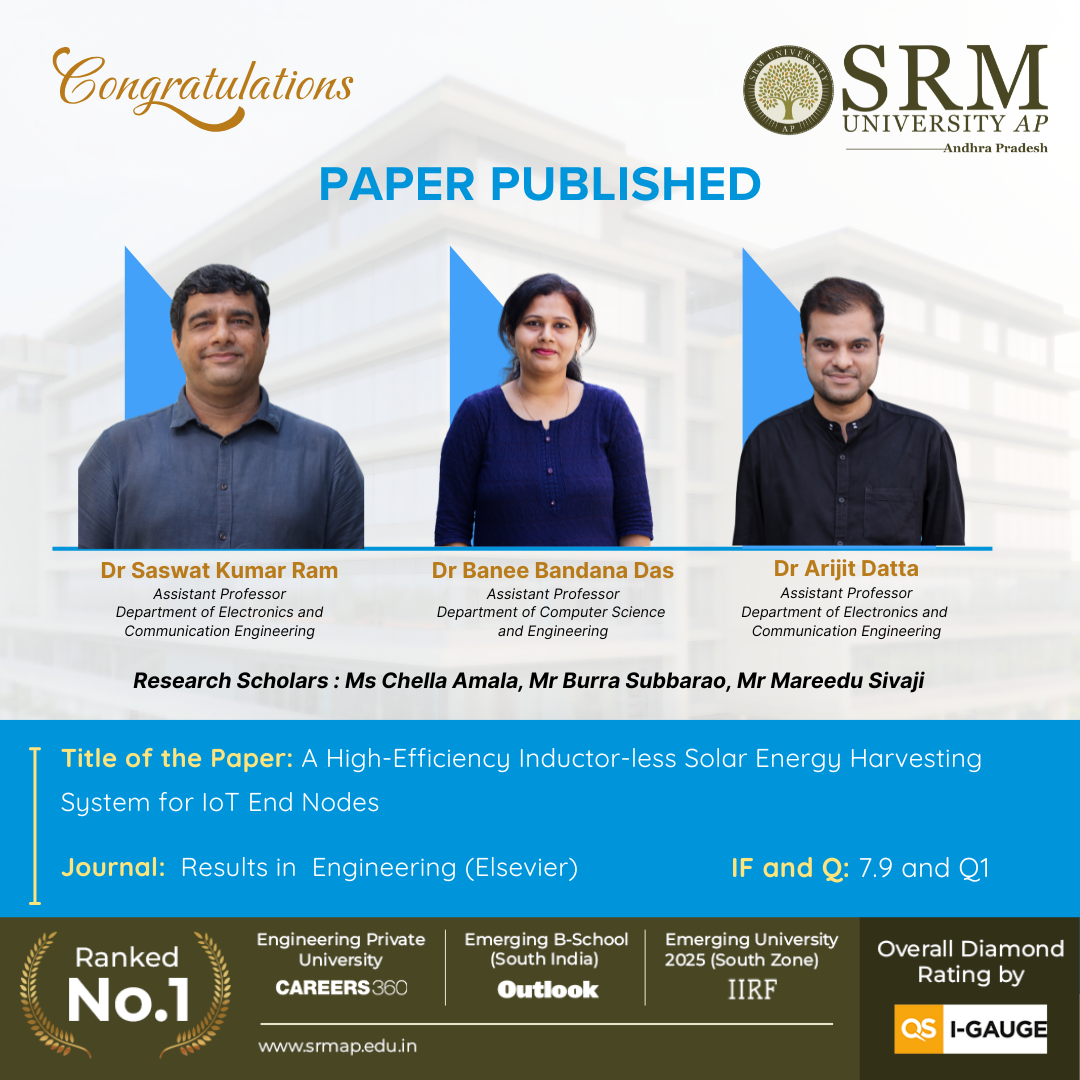
 Dr Saswat Kumar Ram, Assistant Professor, Department of Electronics and Communication Engineering, Dr Banee Bandana Das, Assistant Professor,Department of Computer Science and Engineering Dr Arijit Datta , Assistant Professor , Department of Electronics and Communication Engineering, Assistant Professor Department of Electronics and Communication Engineering along with Ph.D. scholars Ms Chella Amala, Mr Burra Subbarao and Mr Mareedu Sivaji have developed a compact and highly efficient solar energy harvesting system designed to power small electronic devices used in applications such as smart homes, healthcare monitoring systems, and smart cities.
These devices, commonly referred to as Internet of Things (IoT) devices, require reliable and long-lasting power sources to function continuously without frequent charging or battery replacement. To address this challenge, the research team designed a miniature system capable of capturing sunlight and converting it into usable electrical energy efficiently, much like a tiny solar power unit integrated within the device itself.
A key feature of this innovation is its ability to intelligently adapt to changing lighting conditions. Whether exposed to bright sunlight outdoors or dim indoor lighting, the system continuously adjusts the way it collects and manages energy to maintain efficient performance. Additionally, it can provide suitable power levels to different components of a device, ensuring stable and smooth operation at all times.
The system is also highly energy-efficient, meaning very little power is lost during energy conversion and transfer. By reducing dependence on conventional batteries, this technology can help create more sustainable, eco-friendly, and cost-effective electronic systems. The research has strong potential for future applications in wearable medical devices, wireless sensor networks, environmental monitoring systems, and next-generation smart city infrastructure.
A brief abstract of research
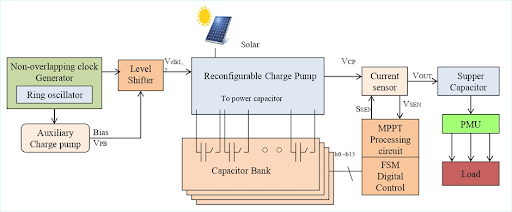
This paper presents, a fully integrated solar energy harvesting system and power management unit (SEHS-PMU) for ultra-low-power IoT applications is presented in this research. Instead of bulky inductors, the 45 nm CMOS device uses a reconfigurable charge pump (RCP) architecture to convert energy efficiently. Maximum power point tracking (MPPT) optimizes solar cell energy extraction under different light situations. Additionally, capacitor value modulation (CVM) matches impedance for compact monolithic integration. Proposed RCP-based DC–DC converter has 95% peak power conversion efficiency. On-chip low-dropout regulators (LDOs) provide controlled output voltages of 2.8 V, 1.3 V, and 0.7 V for IoT, smart city, and IoMT sensor nodes. The tiny, energy-efficient SEHS-PMU power management technology allows next-generation self-powered IoT devices to operate sustainably.
Practical implementations
Self-powered electronic gadgets without battery replacement or external charge are the practical application of this research. Small devices like environmental sensors, wearable health monitors, smart agriculture nodes, and smart city infrastructure can use the suggested solar energy harvesting and power management system. The tiny, component-free solution is suitable for mass production and may be incorporated directly into IoT chips. This makes it handy in isolated or hard-to-reach areas where battery replacement is expensive or complicated. Reducing disposable battery use, which harms the environment, helps social sustainability. It reduces the environmental impact by using renewable solar energy to develop green technology. Continuous monitoring devices (IoMT) can improve patient care without frequent maintenance in healthcare. Such systems can power vital sensing and communication devices in rural and developing areas, closing the technology gap. The research promotes energy-efficient, low-maintenance, and environmentally friendly solutions to meet society’s growing demand for sustainable and scalable IoT technology.
Collaborations
Suitable collaborations for this work can involve leading semiconductor, IoT, and technology companies to enhance both development and deployment. Collaboration with semiconductor companies would be highly beneficial for chip fabrication, optimisation, and scaling of the proposed SEHS-PMU design using advanced CMOS technologies. Partnerships with IoT and embedded system companies like Cisco, Bosch, and Siemens can support integration of the power management system.
Future research plans
The future research direction will focus on improving system efficiency and adaptability through advanced MPPT algorithms, optimised ultra-low power control circuits, enhanced energy storage management, and support for multi-source energy harvesting in advanced CMOS technologies for next-generation autonomous IoT systems.