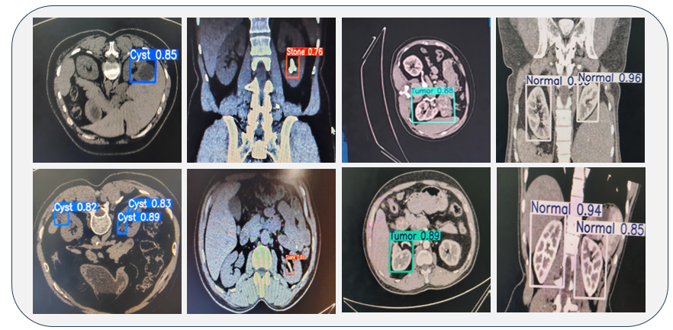
The research team from the Department of Electronics and Communication Engineering has developed an intelligent and lightweight computer-based system that automatically detects and classifies kidney abnormalities, including kidney stones, kidney tumours, kidney cysts, and normal kidney conditions, from CT scan images.
Dr Arijit Dutta and Dr Swagata Samanta, Assistant Professors, along with PhD scholar Ms A Pushpavathi Kothapalli, have proposed a system that assists healthcare professionals by providing fast, accurate diagnostic results, thereby supporting early disease detection and reducing diagnostic time. Since it can operate efficiently on low-cost embedded devices without relying on cloud computing, it is suitable for real-time use in hospitals, rural healthcare centres, mobile clinics, and remote healthcare settings, improving access to quality diagnostic services.
Their patent titled “System and Method for Real-Time Kidney Abnormality Detection and Classification Using Lightweight Edge Intelligence” has been published with the application no. 202641072330 by the Indian Patent Office Journal.
Abstract
A system and method for real-time detection and classification of kidney abnormalities from computed tomography (CT) images using a lightweight deep learning framework deployed on embedded edge devices are disclosed. The system comprises a CT image source, an image acquisition module, a preprocessing module, a lightweight deep learning inference engine including a feature extraction module and a detection and classification module, an embedded edge deployment module, an edge computing device, an output visualization module, and a user interface and clinical display module. The framework detects and classifies kidney stones, kidney cysts, kidney tumors, and normal kidney conditions. The inference engine comprises approximately 6.4 million trainable parameters and operates at approximately 15.4 GFLOPs, enabling low-latency real-time inference on resource-constrained embedded devices for clinical, telemedicine, and remote healthcare applications.
Practical Implementation/ Social Implications of the Research
The proposed lightweight deep learning framework can be practically implemented in hospitals, diagnostic centres, rural healthcare facilities, mobile medical units, and telemedicine systems to enable rapid and accurate kidney abnormality detection from CT scan images. Its ability to operate on low-cost embedded edge devices without relying on cloud computing makes it suitable for deployment in resource-constrained environments. The invention has significant social implications by facilitating early diagnosis, reducing diagnostic delays, improving access to quality healthcare in remote regions, and supporting healthcare professionals in delivering timely and reliable patient care.
Future research will focus on enhancing the proposed lightweight framework by incorporating advanced artificial intelligence techniques to improve diagnostic accuracy and expand its capability to detect additional kidney diseases and other abdominal abnormalities. The work will also explore optimisation for newer embedded edge platforms, integration with cloud-assisted telemedicine systems, and clinical validation using larger multi-centre datasets to support widespread deployment in real-world healthcare environments.
Read the full article