


 Today, drone images are widely used in important areas such as surveillance, disaster monitoring, remote sensing, agriculture, infrastructure inspection, and defence. These images often travel through wireless networks before reaching the receiver. During this process, someone may change a part of the image, move one region to another place, or copy one or more parts from another image.
The problem is that such tampered images may still look normal to the human eye. However, even a small change in the image can lead to wrong decisions, especially in sensitive applications such as disaster assessment, border monitoring, or infrastructure inspection.
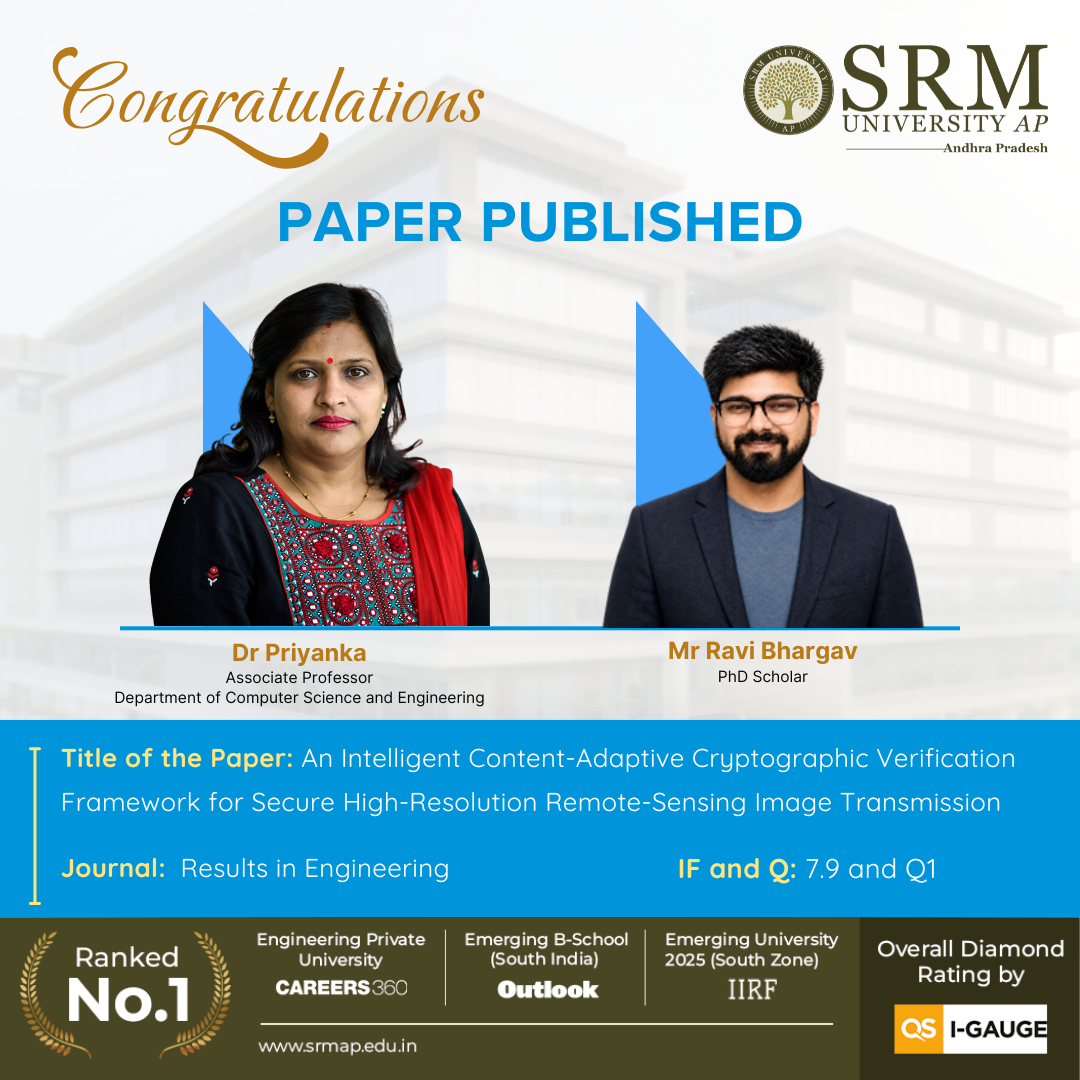
The Research published by Dr Priyanka Singh, an Associate Professor from the Department of Computer Science and Engineering at SRM AP, in the Q1 journal of Results in Engineering, having an impact factor of 7.9, titled An Intelligent Content-Adaptive Cryptographic Verification Framework for Secure High-Resolution Remote-Sensing Image Transmission provides a security method that checks whether every part of the image is genuine and whether it is still present in its correct position. The image is divided into meaningful blocks, and each block is protected with its own security information. If any block is changed, moved, swapped, or copied from another image, the system detects it before decryption and highlights the affected region.
This research was carried out by Ravi Bhargav, a Ph.D. Scholar, under the supervision of Dr Priyanka Singh, in the Department of Computer Science and Engineering at SRM University-AP
This method developed by the researchers works like a security checker for drone images. It ensures that the received image is authentic, secure, and trustworthy.
Abstract
This research focuses on securing images captured and transmitted by Unmanned Aerial Vehicles (UAVs). Since UAV images are often transmitted through wireless or open networks, they may be modified, copied, relocated, or misused by unauthorized users. To address this issue, a structure-based block-wise image authentication framework is proposed for secure transmission and tamper localization. The proposed method divides the image into content-adaptive blocks, where detailed regions are represented using smaller blocks and smooth regions are represented using larger blocks. Each block is protected by linking its visual content, spatial position, and structural context with authenticated encryption. This helps detect not only pixel-level modifications, but also structural attacks such as block swapping, block relocation, and copying of image regions from another image. The framework was evaluated on 1000 grayscale and colour images with resolutions ranging from 256 × 256 to 2048 × 2048. The experimental results achieved an overall tamper-detection rate of 98.9%, localisation accuracy of 98.2%, and a false positive rate of 1.3%. The method also maintained high reconstruction quality, reaching up to 37.45 dB PSNR and 0.9993 SSIM.
Practical Implementation and Social Implications
The proposed research can be practically implemented in secure UAV-based image transmission systems where image authenticity and integrity are important. It can be used in surveillance, remote sensing, disaster monitoring, agriculture, defence, smart city monitoring, infrastructure inspection, and forensic applications.
The social impact of this research is that it can improve trust in digital image communication. In critical situations such as disaster response, border surveillance, road damage assessment, or environmental monitoring, decisions are often made based on captured images. If such images are manipulated, the decisions may become incorrect. The proposed method helps ensure that transmitted images are genuine, secure, and reliable before they are used for decision-making.
Key Benefits
- Secure transmission of UAV and aerial images
- Detection of image tampering before decryption
- Identification of the exact tampered region
- Protection against block swapping, relocation, and copying attacks
- Improved trust in image-based decision-making
In future, this work can be extended toward real-time UAV image transmission and lightweight deployment. The framework can also be improved for large-scale remote sensing images, medical images, and AI-generated image authentication. Future research may also explore faster verification methods, quantum-inspired security mechanisms, and integration with cloud-based or edge-based secure image transmission systems.
Read the full article here