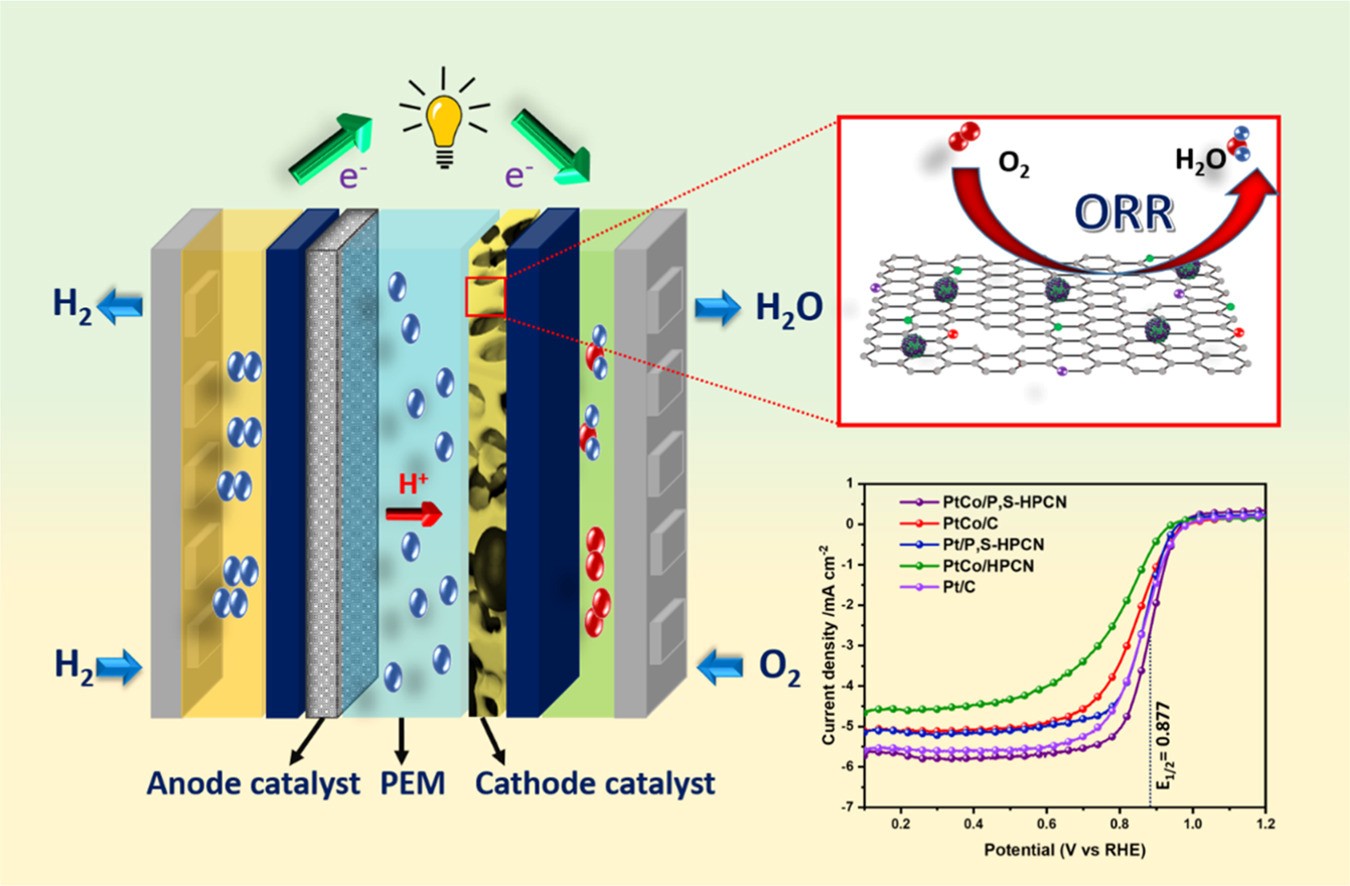

 In the current global energy landscape, the urgent need to mitigate climate change, reduce reliance on fossil fuels, and transition toward sustainable energy systems has intensified interest in hydrogen fuel cells as a clean and efficient energy conversion technology. However, the large-scale deployment of fuel cells is constrained by the high cost and durability limitations of platinum-based catalysts. In this context, the research by Dr Narayanamoorthy Bhuvanendran, Assistant Professor from the Department of Environmental Science and Engineering, SRM AP addresses these critical challenges through the development of an advanced electrocatalyst that enhances platinum utilization while maintaining high catalytic activity and long-term stability. His research is published on the Q1 journal of Surfaces and Interfaces having an impact factor of 6.3, titled “Surface engineered P,S-doped hierarchical carbon nitride supporting ultrafine PtCo nanoparticles for high performance oxygen reduction”
By integrating ultrafine platinum–cobalt alloy nanoparticles with a heteroatom-doped hierarchical porous carbon nitride framework, the catalyst promotes efficient reactant transport, improved active-site accessibility, and optimized reaction kinetics. The synergistic effects of tailored nanostructure design, heteroatom doping, and alloy engineering contribute to enhanced catalytic performance and durability, offering a promising strategy for reducing precious metal usage and improving fuel cell efficiency. This advancement represents an important step toward the commercialization of cost-effective and sustainable fuel cell technologies, supporting the broader transition to a low-carbon and hydrogen-based energy future.
Abstract
Maximize the Pt utilization with high durability and efficient mass transport is crucial on the electrocatalyst design for the practical low-temperature fuel cell applications. In this work, we designed an ultrafine PtCo alloy nanoparticles distributed uniformly on phosphorus and sulfur co-doped hierarchical porous carbon nitride (PtCo/P,S-HPCN), synthesized via hydrothermal treatment, pyrolysis, and chemical reduction. The heteroatom-doped carbon nitride framework exhibits superior chemical stability compared to conventional carbon materials, while its hierarchical porous structure facilitates uniform dispersion of ultrafine PtCo nanoparticles (∼1.8 nm) and accelerates reactant transport. Synergistic effects from graphitic/pyridinic nitrogen species, P/S doping, and Pt–Co alloying modulate the electronic structure of Pt, optimizing *OOH binding and enhancing ORR kinetics. The optimized catalyst delivers excellent performance in acidic media, achieving a high half-wave potential (0.88 V vs. RHE), a mass activity of 0.91 mA µgPt⁻1, and a specific activity of 2.37 mA cmPt⁻2 at 0.85 V. Remarkably, it retains 73% of its initial mass activity and loses only 11 mV in half-wave potential after 5000 durability cycles. In practical PEMFC tests, the PtCo/P,S-HPCN cathode achieves a peak power density of 0.42 W cm⁻², surpassing commercial 40 wt% Pt/C. This study demonstrates a promising strategy for designing durable, low-Pt and high activity catalysts for PEMFC applications
Practical Implementation and social implications
The developed electrocatalyst can be practically implemented in proton exchange membrane fuel cells (PEMFCs) for applications such as electric vehicles, portable power systems, backup power units, and distributed clean energy generation. By improving catalyst efficiency and durability while reducing dependence on expensive platinum, the technology can contribute to lowering the overall cost of fuel cells and enhancing their commercial viability. The use of advanced nanostructured materials also supports the development of next-generation energy conversion devices with improved performance and reliability.
From a societal perspective, this research promotes the adoption of clean hydrogen-based energy technologies, which can help reduce greenhouse gas emissions, improve air quality, and decrease dependence on fossil fuels. The advancement of affordable and durable fuel cell systems can accelerate the transition toward sustainable transportation and renewable energy integration, contributing to global energy security and environmental sustainability. Furthermore, the development of efficient low-platinum catalysts supports the broader goals of a low-carbon economy and sustainable technological innovation
Collaborations:
Huaneng Su, Jiangsu University, China.
Future research plans:
Future research will focus on developing advanced low-platinum and platinum-free electrocatalysts with improved activity, durability, and cost-effectiveness for fuel cells and related energy conversion technologies. Emphasis will be placed on nanostructure engineering, heteroatom doping, and understanding catalyst reaction mechanisms to enable scalable and sustainable clean energy solutions.