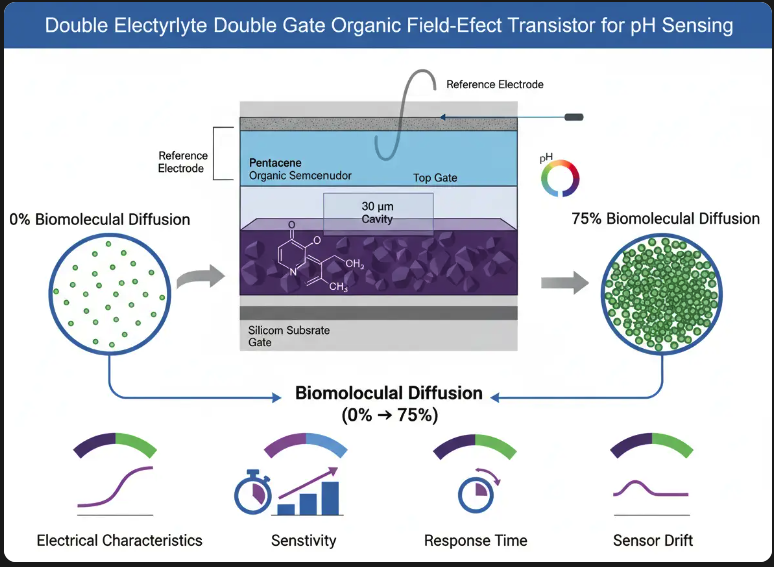
 Biomedical diagnostics rely heavily on the development of precise, accessible, and cost-effective monitoring technologies. Dr. M. Durga Prakash, Associate Professor from the Department of Electronics and Communication Engineering, SRM AP and Mr. Meena Nagaraju (PhD Scholar) addresses this need by engineering an advanced electronic sensor capable of detecting critical biochemical variations within human biofluids, including blood, saliva, and sweat. This research has been published as ‘Modeling and Performance Evaluation of a Double-Gate Organic FET pH Sensor Considering Biomolecular Diffusion Effects’ on the Q1 journal of IEEE Access, having an impact score of 3.6. By tracking pH dynamics, which serve as vital indicators of systemic physiological shifts, this research establishes a foundation for earlier and more accessible health interventions.
The significance of this study lies in its potential to transform patient care through the optimization of low-cost, flexible, and highly sensitive diagnostic machinery. Utilizing the organic semiconductor pentacene, the researcher investigates the temporal transport and behaviour of biological molecules within the sensing device. The resulting insights offer critical advancements in sensor accuracy and efficiency, bridging the gap between organic electronics and real-world medical applications.
Abstract
This research proposes and numerically investigates a Double Electrolyte Double Gate Organic Field-Effect Transistor (EDG-OFET) for pH sensing applications in biological fluids. Pentacene is used as the organic semiconductor, and a 30 µm cavity is introduced at the oxide/organic semiconductor interface to regulate biomolecular diffusion. The study analyzes the impact of biomolecular diffusion (0%–75%) on electrical characteristics, sensitivity, response time, and sensor drift. Results show that increasing diffusion significantly reduces sensitivity, highlighting the critical role of diffusion dynamics in biofluid-based diagnostic sensing applications.
Practical Implementation / Social Implications
The proposed EDG-OFET pH sensor can be used in healthcare diagnostics for real-time monitoring of body fluids such as saliva, sweat, and blood. The research contributes to the development of low-cost, flexible, and portable biosensors suitable for wearable healthcare systems. It can support early disease detection, personalized healthcare monitoring, and point-of-care diagnostic applications.
Future Research Plans
Future research will focus on experimental fabrication of the proposed EDG-OFET sensor, integration of flexible and wearable substrates, enhancement of sensitivity and response time, detection of specific biomolecules such as glucose, DNA, and proteins, and optimization of electrolyte materials for practical biomedical applications.