


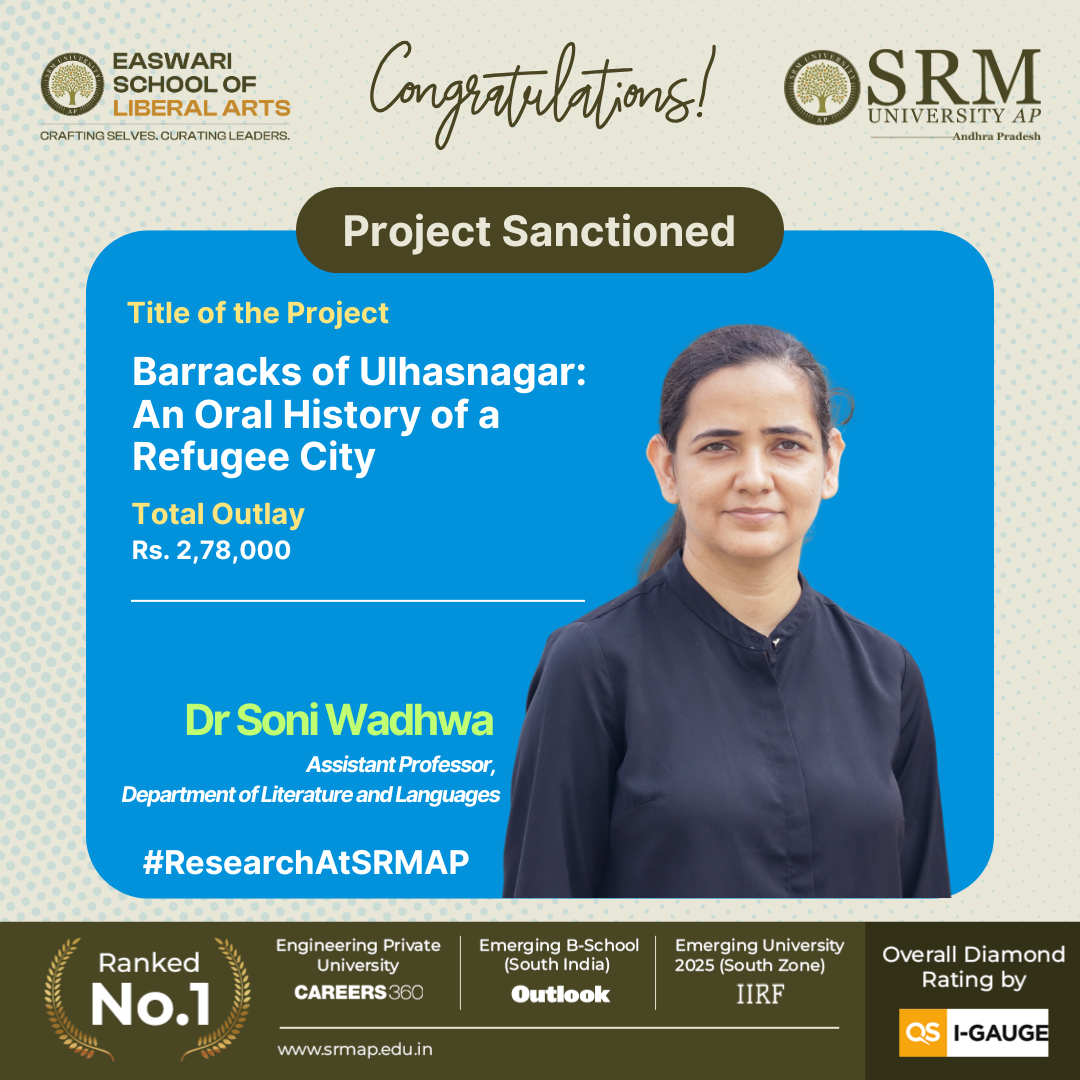
 Dr Soni Wadhwa, Assistant Professor, Department of Literature and Languages, receives a project titled “Barracks of Ulhasnagar: An Oral History of a Refugee City” with a total outlay of Rs. 2,78,000 funded by Wikimedia Foundation and Balarc Foundation.
The project documents the history of Ulhasnagar as its current and former inhabitants remember it. Their oral narratives reflect on the past, present, and future of Ulhasnagar and its problems related to urban infrastructure and Sindhi identity.
Brief Abstract
The project, “Barracks of Ulhasnagar: An Oral History of a Refugee City,” seeks to address the critical decline of the Sindhi language in India and document the unique history of the Ulhasnagar township in Maharashtra. Sindhi, a South Asian language, faces the threat of disappearance in India as its speakers, who migrated from Sindh during the Partition, are adopting local languages and ceasing to use Sindhi even at home, largely due to its absence in academic and governance spheres. To revitalise the language and document its oral culture, the project is building a specialised archive focusing on Ulhasnagar, one of India’s largest Sindhi settlements, which originated as the Kalyan Camp refugee settlement.
The oral histories will specifically capture citizens’ memories of migration, their experience of displacement, and the subsequent housing crisis, which includes the collapse of poorly built buildings and the construction of illegal structures. A particular focus is placed on the barracks—historical structures used to house World War II soldiers that still organise the city but remain unexplored within housing and informal housing typologies. The narratives will also explore contemporary issues, such as the social stigma associated with barracks and the recent exodus of Sindhis searching for better housing.
Funding agency and amount sanctioned.
Funding agency: Wikimedia Foundation and Balarc Foundation
Amount Sanctioned: Rs. 2,78,000
Practical implementation:
The project documents Sindhi language through oral narratives.
It draws attention to infrastructural problems of Ulhasnagar from the point of view of its citizens.
It also highlights the dilemmas faced by Sindhis as they live and exit the largest Sindhi township in India.
It also offers a model for understanding issues around refugee housing and settlements.
Your collaborations
Citizens of Ulhasnagar who volunteer to share their oral narratives are the greatest contributors and collaborators to this history.
The Co-PI for the project is Neelima Motwani ,a Lecturer of Hindi in the Junior College of Smt CHM College, Ulhasnagar. She has been the Lead Coordinator and involved in Quality Assessment for Sindhi Language, AI4Bharat programme by IIT Madras. She has expertise in digitisation of Sindhi books. She has also been translator and reviewer of translation quality for Sindhi at Rekhta Foundation.
Your future research plans
This project is a part of my larger work on Sindhi Studies. Some parts of it related to archives and literature has been published. As an addition to my current digital archives, PG Sindhi Library, Sindhi Halchal Archive, and Sindhi Sanchaya, this Barracks of Ulhasnagar helps me extend archives to the platform of Wikimedia Commons. I look forward to strengthen the space of Wiki-GLAM with more of these projects.